
Male or Female AI Voice: What Do Listeners Prefer?
Among Éist users with a full voice catalogue, AI voice preference splits roughly 60/40 female to male — far closer than headline figures suggest.

When people choose an AI voice for listening, the preference is more balanced than most assume. Among Éist users who had access to a full voice catalogue — Pro subscribers with both male and female voices actually available to pick — roughly 60% chose a female voice and 40% chose a male voice (n=255, 90-day window). That is a real lean toward female voices, but far from overwhelming, and the story behind why this number is smaller than headline figures suggest is worth understanding before drawing any conclusions about listener taste.
Why the obvious figure is wrong
Pull voice-choice data across all users of any text-to-speech app and female voices tend to dominate. The tempting interpretation is that listeners strongly prefer female AI narrators. The accurate interpretation is usually simpler: female voices are what the free tier ships.
In Éist’s case, the free tier includes three voices — one per synthesis engine — and all three are female. Male voices are part of the expanded catalogue unlocked by Éist Pro ($4.99/month). An all-user breakdown, then, does not measure preference. It measures availability. Conflating the two produces figures that look dramatic and say almost nothing about what listeners would actually choose if given a real choice.
The corrected figure requires restricting the sample to users who had a genuine selection. Among Éist Pro subscribers with access to the full voice catalogue (n=255, 90-day window), voice selection ran approximately 60% female, 40% male. That is the preference figure. Everything else is a confound.
This kind of availability bias appears frequently in AI voice reporting and is worth naming whenever you encounter a claimed preference split that does not describe what voices were actually on offer.
What a 60/40 split means in practice
A 60/40 split is a genuine preference signal — female voices are chosen more often — but it is a mild one. Four in ten listeners with a full catalogue reached for a male voice. If you are building a product, choosing a default narrator, or setting up a personal listening workflow, that is not a number you can safely dismiss.
Several factors plausibly contribute to the gap without being easy to isolate cleanly from aggregate data:
Genre and content type. A listener working through a romance novel and one working through a history of naval warfare have different intuitions about whose voice they want to hear. Voice preference research in human-computer interaction has consistently found that content context shapes reactions to narrator voice — meaning a broad all-genre average like 60/40 is best understood as a starting point, not a universal truth about individual listeners.
Familiarity and inertia. Some listeners stick with the first voice they try. If the default experience is female — as it is on Éist’s free tier — listeners who later upgrade to Pro may carry that familiarity forward rather than actively reconsidering. The 60% is partly a preference and partly a path-of-least-resistance effect that is difficult to disentangle from data alone.
Variation within a gender category. Éist offers 17 Piper voices, plus voices across the Supertonic and Kokoro synthesis engines. “Female voice” covers a range of tones, accents, and pacing styles. A listener who reaches for a female voice may be more specifically choosing a warmth or register that happens to be available in the female voices they encountered first, rather than expressing a categorical gender preference.
None of these factors can be fully separated from the 60/40 aggregate. They are worth keeping in mind before over-interpreting a single split figure.
Does preference vary by use case?
This is a natural follow-up question, and the honest answer is that Éist’s current data does not support a breakdown by genre, session length, or content type. The 60/40 figure is an aggregate across the full catalogue and all book types that Pro subscribers read during the measurement window.
What is plausible, based on listening-speed data, is that non-native English listeners may weight voice characteristics differently. Among Éist users who adjust playback speed (n=1,986, 90-day window), roughly one in five settles below realtime. Those slower-preference listeners skew toward non-English locale users: 14.6% of that slower-listening group have a non-English locale setting, versus 9.9% of speed-adjusters overall. The denominator here is speed-adjusters only, not all users — so this is not a claim about the full user base.
The implication for voice preference is limited but suggestive: clarity and pace likely matter more to listeners following in a non-native language than voice gender does. If you are choosing a voice for a language-learning context, testing at a slower speed across a few voices — regardless of gender — is probably more useful than defaulting to the aggregate preference.
How to actually choose a voice
The most reliable method is to hear voices on real prose before committing. Abstract descriptions like “warm,” “professional,” or “authoritative” are poor predictors of whether a voice holds attention across a three-hour book.
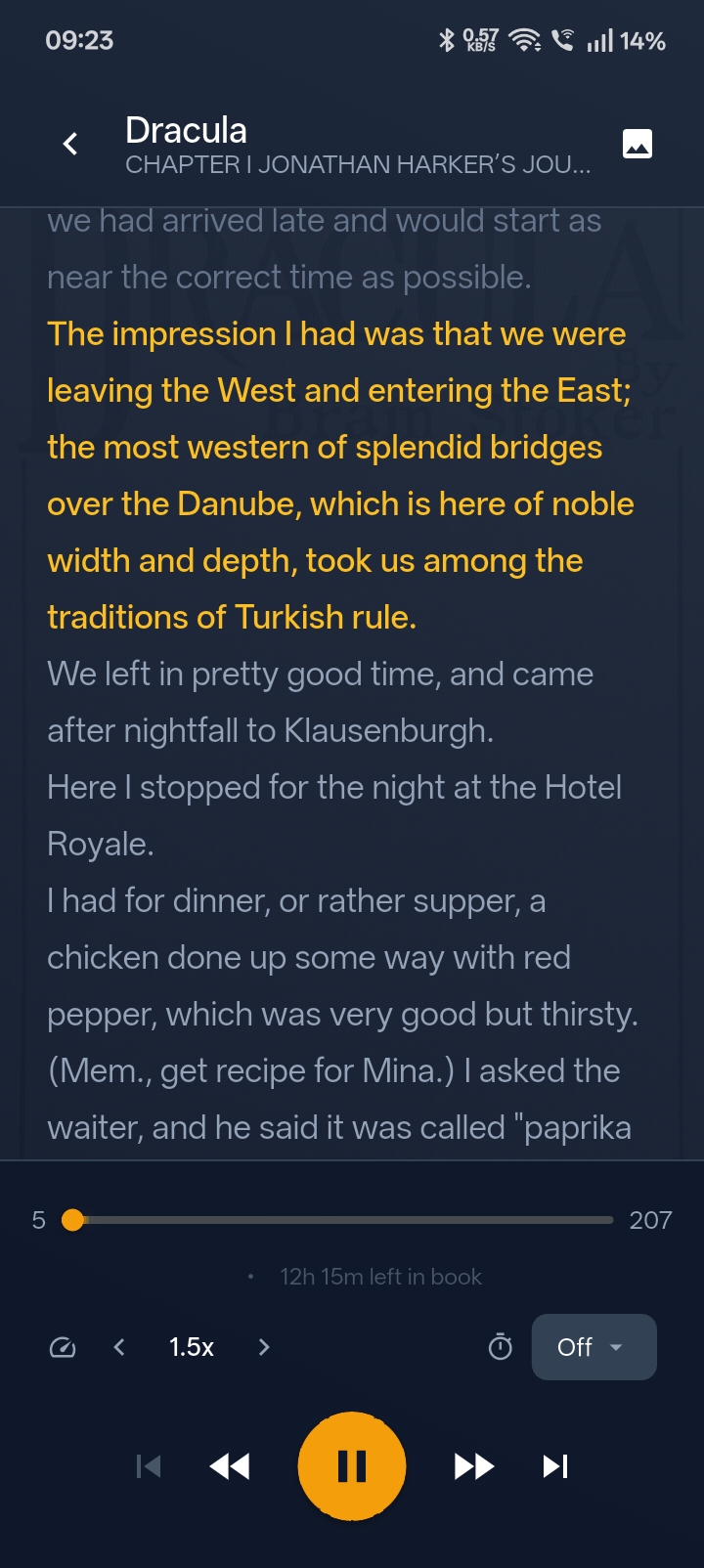
Éist offers 65 short literary quote previews — one per voice — with per-word timing data so the preview text highlights in sync exactly as it does during real narration. You hear not just the voice in isolation but how it moves through prose at reading pace. That is the relevant test.
| Question to ask yourself | Why it matters |
|---|---|
| Does the voice work for the genre you read most? | A voice suited to dry technical prose can feel flat in literary fiction, and vice versa |
| Can you distinguish character dialogue from narration? | Some listeners find certain voices more expressively varied; this matters more in fiction than non-fiction |
| Does the pacing feel natural at your preferred listening speed? | Voice character shifts when you push speed up; preview at the speed you normally use |
| Do you carry strong habits from other listening? | Long-time audiobook listeners often anchor to whatever voice style they learned on — the first few chapters at a new voice feel different regardless of quality |
| Are you listening in your non-native language? | Enunciation and pacing clarity tend to matter more than gender in this context; prioritise voices that sound unhurried at your listening speed |
The table above is a checklist, not a ranking. Work through it with a short sample chapter in the genre you plan to read.
For more on how on-device text-to-speech apps handle voice selection and audio quality, see the guide to the best offline text-to-speech apps in 2026. If you are starting from an EPUB library and want a full walkthrough of the narration workflow, the complete guide to EPUB text-to-speech covers import, synthesis, and voice selection end to end.
Frequently asked questions
Q: Do most people prefer female AI voices?
Among Éist Pro users with access to the full voice catalogue (n=255), roughly 60% chose a female voice. That is a majority, but a modest one. Much larger female-preference figures reported elsewhere typically reflect availability rather than choice — free tiers often ship only female voices, so all-user tallies measure what was on offer, not what listeners would have picked freely.
Q: Does voice gender affect comprehension or listening enjoyment?
Research on this question in human-computer interaction suggests the effect is real but small and highly context-dependent — it interacts with content type, listener background, and task. Practical testing on your own content is a more reliable guide than applying average findings from unrelated listening contexts.
Q: Should I default to a female AI voice for a project?
The 60/40 split in Éist’s data suggests a female default is mildly more likely to match a random listener’s preference, but 40% is a large enough minority that building in a voice-selection step — or at least a setting — is worth it wherever the product allows for it. A default is a starting point, not a permanent assignment.
Q: How do I try AI voices before committing?
In Éist, 65 literary quote previews let you hear each voice reading an actual prose passage, with text highlighted word by word in sync with playback. Choosing a preview passage from a genre similar to what you plan to read gives a realistic impression of how the voice will hold up over longer sessions. First impressions from short, decontextualised clips often differ from sustained listening impressions.
Q: Is there a “correct” voice for audiobooks?
No. The 60/40 split confirms that a large fraction of listeners actively prefer male narrators even when both options are available. What matters is whether a specific voice works for a specific listener with a specific kind of content. The aggregate preference figure is a reasonable null hypothesis — not a reason to skip individual preference testing.
Get started
If you want to form your own answer to the male-or-female voice question, the most direct route is to listen to a few voices on a passage from a book you already plan to read. Éist lets you switch voices on an imported EPUB or PDF without starting over from scratch.
For a broader look at how text-to-speech has developed as a listening medium, see the complete guide to text-to-speech apps in 2026. If you are weighing whether on-device synthesis is the right fit for your use case — relevant if privacy or offline access is part of your decision — offline vs cloud text-to-speech covers the tradeoffs in detail.